🎯 The Challenge
The client wanted to publish curated news content to Telegram and Facebook consistently, without burning hours each day on monitoring, summarizing, and formatting. But they also weren't comfortable with fully autonomous AI posting — they wanted a human check before anything went live, with all of it tracked in one place.
Goals:
- Automated monitoring of specific news sources
- Automatic summarization and post creation from new articles
- A convenient approve/reject interface for the human reviewer (Telegram)
- Structured publishing to Telegram and Facebook once approved
- Central tracking of all posts and statuses in Google Sheets
🧩 The Solution
A pipeline of Make.com scenarios that watches a source, drafts a post with OpenAI, routes it through a Telegram approval bot, validates the approved content, and then publishes to both Telegram and Facebook — with every step logged in Google Sheets.
01
From website to Telegram — drafts & summaries
Scenario 1 monitors a website or RSS feed for new articles. When a new one
appears, it:
- Fetches the article content
- Summarizes it via the OpenAI API
- Generates a preliminary post (text, link, optional hashtags)
02
Validation & post preparation
Scenario 2 triggers when the reviewer interacts with the Telegram bot. On
approval, the system:
- Flags the article as selected in Google Sheets
- Runs additional validation checks (e.g., cross-referencing other sources, Prepl-style content checks)
- Generates the final post text and stores it in Google Sheets, ready to publish
03
Approval tracking & publishing
Scenario 3 regularly checks Google Sheets for posts marked approved
and publishes them automatically to:
- Telegram (channel or group)
- Facebook (page)
04
Streamlined two-scenario variant
Optional
Depending on the client's needs and Make.com operation budget, the three-scenario
flow can be consolidated into two:
- One scenario for monitoring + drafting + approval
- One scenario for validation + publishing
🛠 Tools & Stack
Orchestration
Make.com (Integromat) — all flows, API calls, and routing
AI & generation
OpenAI API — summarization and post text generation
Approval interface
Telegram bot — for one-tap human approval from a phone
Publishing
Telegram channel/group API, Facebook Pages API
Tracking & storage
Google Sheets — status tracking, content storage, lightweight analytics
📈 Results & Impact
- End-to-end automation — from article detection to published post, the pipeline handles every repetitive step.
- Manual workload drastically reduced — no more monitoring sites, copy-pasting articles, or rewriting summaries by hand.
- Quality stays high — structured approval and validation steps mean nothing publishes without a human sign-off.
- Full visibility — the Google Sheets log makes it easy to see what was posted, where, when, and with what content.
🖼 Screenshots
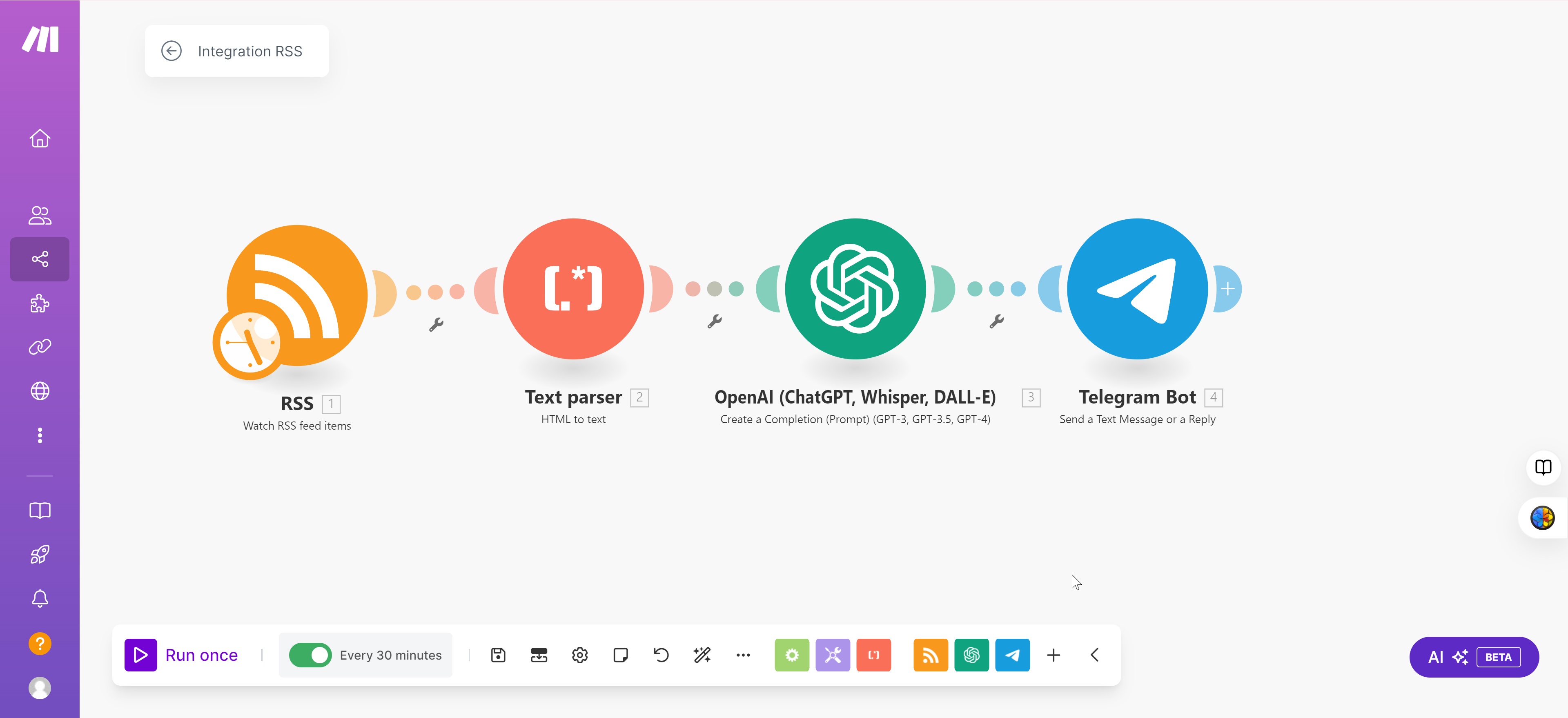
Scenario 1 — RSS to Telegram bot for human approval
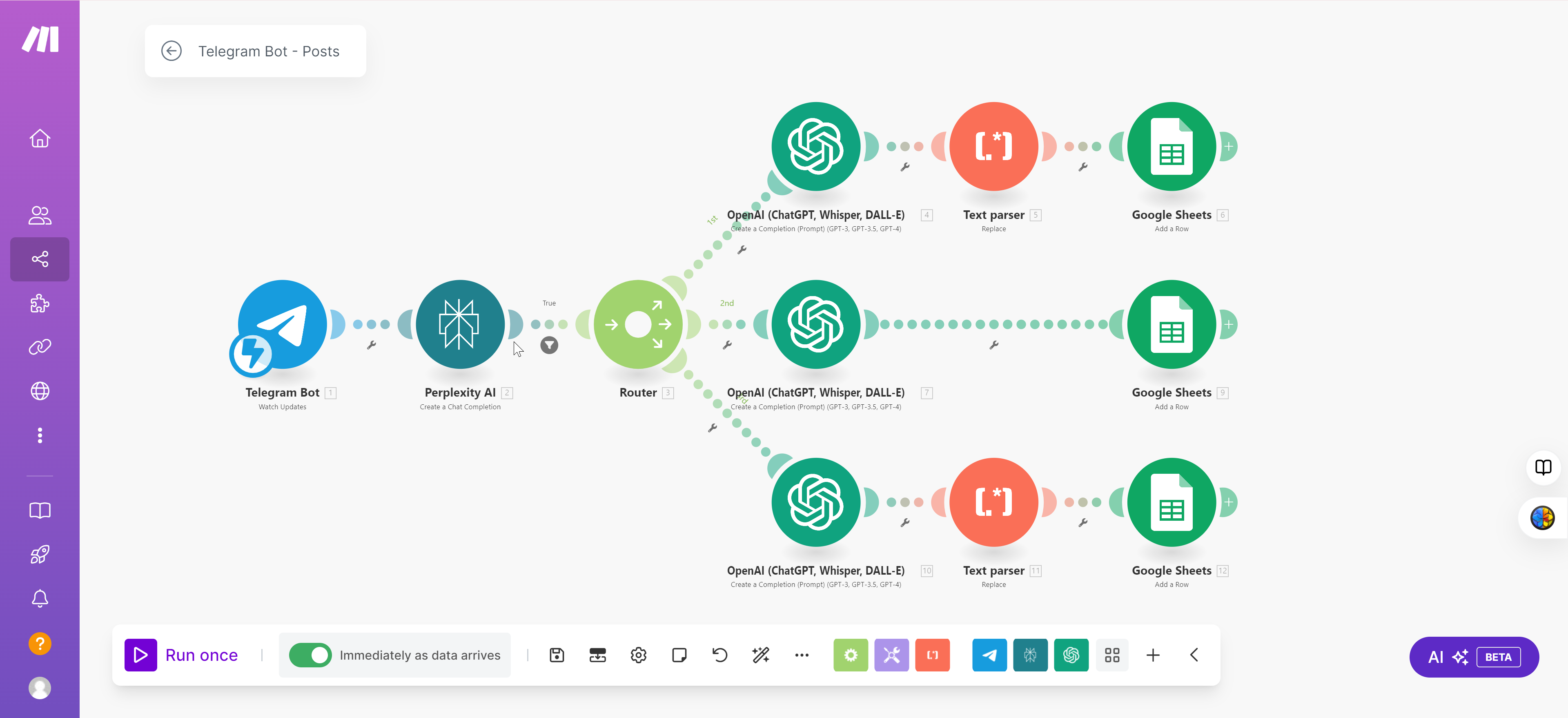
Scenario 2 — validation checks and saving final posts to Google Sheets
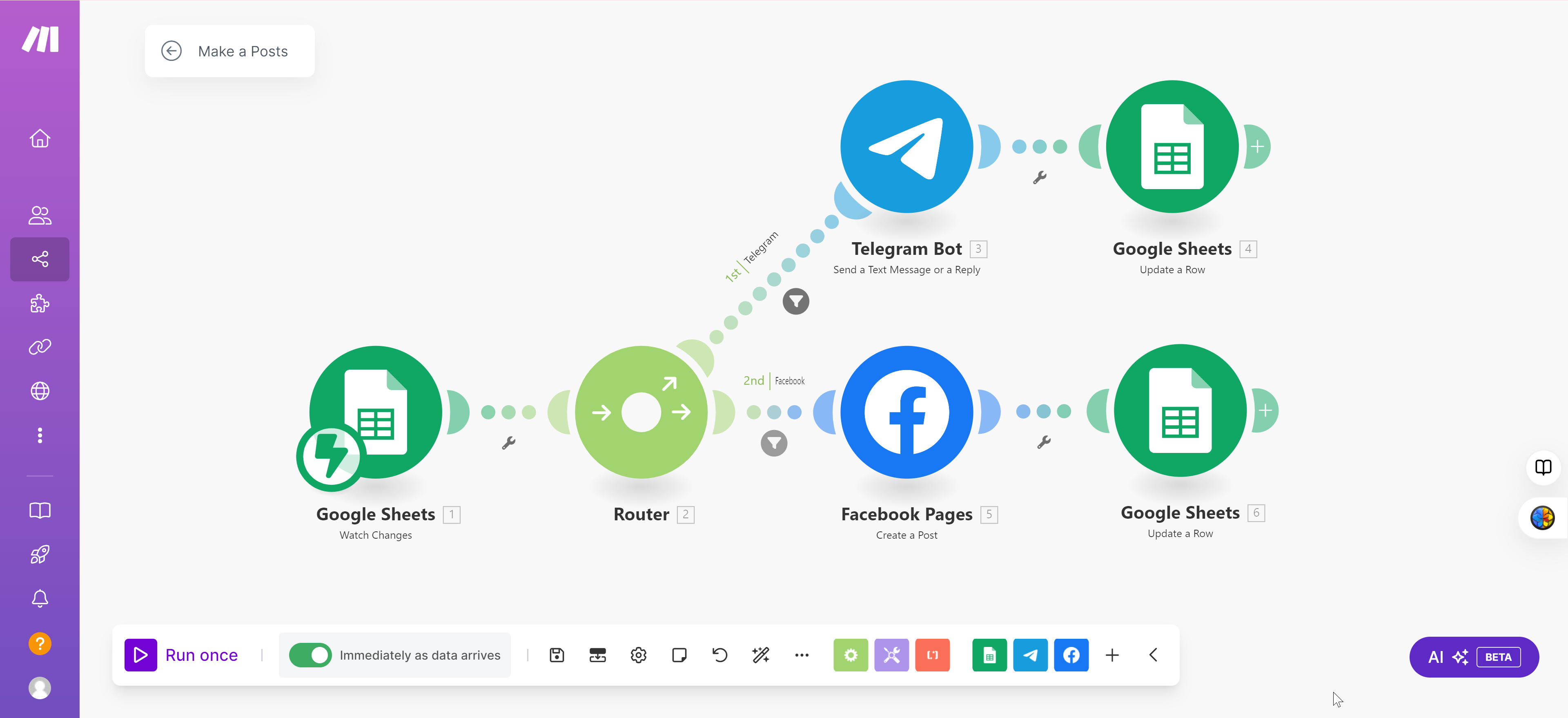
Scenario 3 — publishing approved posts to Telegram & Facebook
Want AI doing the work while you stay in control?
Human-in-the-loop content pipelines, OpenAI-powered drafting, and approval workflows
via Telegram or any other channel — built so automations handle the volume and humans
handle the judgment.